

A welcome only works when people can take part
September 23, 2026
A community event can have a friendly invitation, a packed room and plenty of good intentions—and still leave someone outside the conversation. If the information isn’t accessible, being in the room doesn’t necessarily mean being able to participate.
Today is the International Day of Sign Languages. The United Nations’ 2026 theme, “Declaring Deaf People’s Human Rights,” highlights access through national sign languages. It falls during the International Week of Deaf People, September 21–27. The observance is a useful starting point for looking at the details of a community gathering: the invitation, the planning meeting, the presentation and the conversation afterward.
Source: https://www.un.org/en/node/97859
Start with the people taking part
For a library discussion, community workshop or support-group meeting, planning can begin with a straightforward invitation to explain communication preferences. Give people a clear contact route and put someone in charge of responding. A request shouldn’t disappear into an inbox that nobody checks.
The National Association of the Deaf’s event guidance recommends consulting Deaf and hard-of-hearing community members about the interpreters and captioners being considered. Its guidance also describes the preparation needed to arrange appropriate communication support. Asking early makes room for that work; it also gives participants a chance to explain needs that an organizer might otherwise overlook.
A useful planning conversation is specific. Which parts of the gathering will someone attend? Will there be small-group discussions as well as a presentation? How will a participant ask a question? Who can help if an arrangement fails? These are practical questions to settle with the people involved, rather than assumptions to make from a distance.
Sign languages are languages
The National Institute on Deafness and Other Communication Disorders explains that American Sign Language is a complete natural language with grammar different from English. It also makes clear that there isn’t one universal sign language. An organizer therefore needs to establish which language a participant uses, rather than treating any signing as interchangeable.
Source: https://www.nidcd.nih.gov/health/american-sign-language
People also use different communication methods. Some use sign language; others may use captions, assistive listening technology or another approach. A checkbox labeled “accessible” doesn’t explain which of those arrangements is actually available.
For U.S. organizations covered by the ADA, the Department of Justice’s effective-communication guidance says the appropriate aid or service depends on the communication’s nature, length, complexity and context, along with the person’s usual communication methods. The guidance lists qualified interpreters, real-time captioning and other supports. It does not prescribe one identical solution for every person or interaction.
Source: https://www.ada.gov/resources/effective-communication/
Make the arrangement work in the room
Booking support is part of the preparation. The physical setup matters too. In its festivals and concerts guidance, the NAD calls for lighting and seating that give attendees clear views of the interpreter or captions and the program. A blocked view can undermine an otherwise carefully arranged service.
Source: https://www.nad.org/wp-content/uploads/2020/06/Festivals-and-Concerts.pdf
Before opening the doors, walk through the participant’s route with the people providing access support. Check where the speaker will stand, where questions will come from and whether someone moving across the room could block the view. Include the small moments: introductions, announcements about breaks and changes to the schedule.
For an online gathering, test the actual platform and layout in advance. Confirm how participants will find the relevant video and captions, and explain that process in the joining information. A rehearsal can reveal a problem while there is still time to fix it. Keep a contact available during the session so people can report a difficulty without having to interrupt the entire event.
Keep the conversation open afterward
An access plan can improve with feedback. Offer a clear way for participants to say what worked and what didn’t, then record the practical changes for the next gathering. If a view was blocked or an announcement was missed, that is useful information for the next seating plan or running order.
The same attention belongs in everyday community spaces, including LGBTQ gatherings, disability organizations and neighborhood events. People may have several access needs at once. Let participants describe those needs without expecting them to stand in for everyone else.
A calendar date can draw attention to language access. The follow-through happens in the ordinary work of planning: naming a contact, making arrangements, checking the setup and listening when something needs to change. That is how an invitation becomes an opportunity to take part.
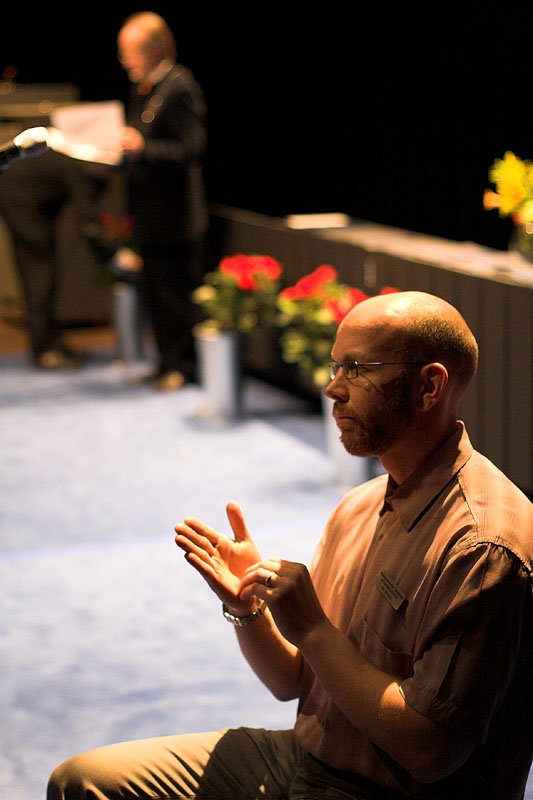
Photo: Sign-language interpreter at an event, May 20, 2005. Archival illustration, not today’s observance; the source does not identify the sign language. Petteri Sulonen / Wikimedia Commons, CC BY 2.0. Platform cropping may apply.
Source: https://commons.wikimedia.org/wiki/File:Sign_language_interpreter.jpg
License: https://creativecommons.org/licenses/by/2.0/
